Your machines announce their failures. Spectra-IO listens.
Wireless vibration sensors on your rotating equipment. Live spectra, trends, and alerts in your browser and on your phone. Running in production today.
2 orgs
run Spectra-IO in production right now
4,000
FFT bins per axis — analyst-grade spectra
Minutes
to install each sensor — no wiring, no shutdown
0
IT projects — the system never touches your plant network
Your plant runs around the clock. So does the monitoring.
The problem
The failure you didn't hear coming.
Bearings and gearboxes don't fail all at once. They degrade quietly for weeks — and then let go in an afternoon. By the time a machine is loud enough or hot enough for a person to notice, the damage is done and the schedule is gone.
Monthly rounds with a portable data collector were designed for a different era. A reading every 30 days misses everything that happens in between — and one unplanned stop on a critical line costs more than years of monitoring it.
Monthly route with a collector
Spectra-IO, continuous
Readings per point
12 per year
Every few hours, every day
Who climbs to the bearing
A technician, each time
Nobody — the sensor lives there
The failure window
Often falls between visits
Watched continuously, alarms included
Trend history
Sparse, hand-carried
Automatic, complete, always online
Listening continuously beats measuring occasionally. The machine tells you what's coming — if something is there to hear it.
The solution
Stick a sensor on it. That's the install.
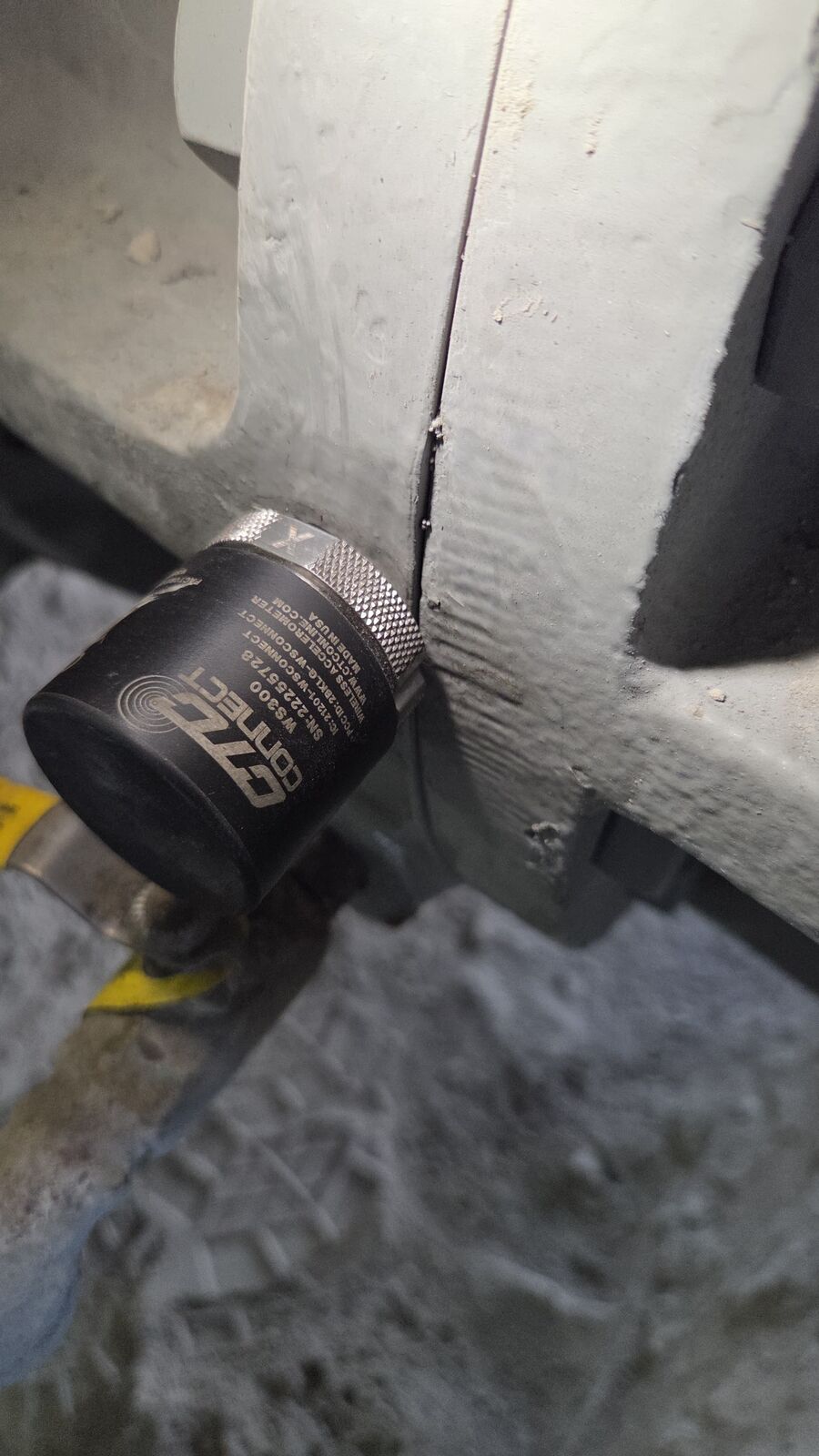
A wireless triaxial sensor mounted on operating equipment — cement dust and all. This is a real installation, not a studio shot.
Sensors
Wireless, triaxial, years on a battery
Industrial vibration + temperature sensors mount on a magnet or stud. No conduit, no cable tray, no electrician.
Gateway
One power outlet — that's the requirement
Collects nearby sensors wirelessly and ships readings out over its own cellular link. Nothing plugs into your network.
Platform
Trends, spectra, and health in one URL
Every machine, every sensor, every reading — organized by plant, equipment, and bearing, in any browser.
Alerts
Threshold crossed → phone notified
Warning, alarm, and critical levels per measurement. When a machine changes behavior, the right people know.
Under the hood
From the bearing to your browser.
The sensors talk to the gateway wirelessly — short-range, low-power radio built for exactly this job.
The gateway brings its own internet — a cellular link with an encrypted tunnel. Your firewall rules don't change, because nothing arrives at your firewall.
The platform does the heavy lifting — storage, FFT analytics, thresholds, and alerting run outside your plant, maintained by us.
Security teams love this architecture for what it doesn't do: it opens no ports, installs no servers, and never touches the plant network.
Deployment
No wires. No servers in your plant. No IT project.
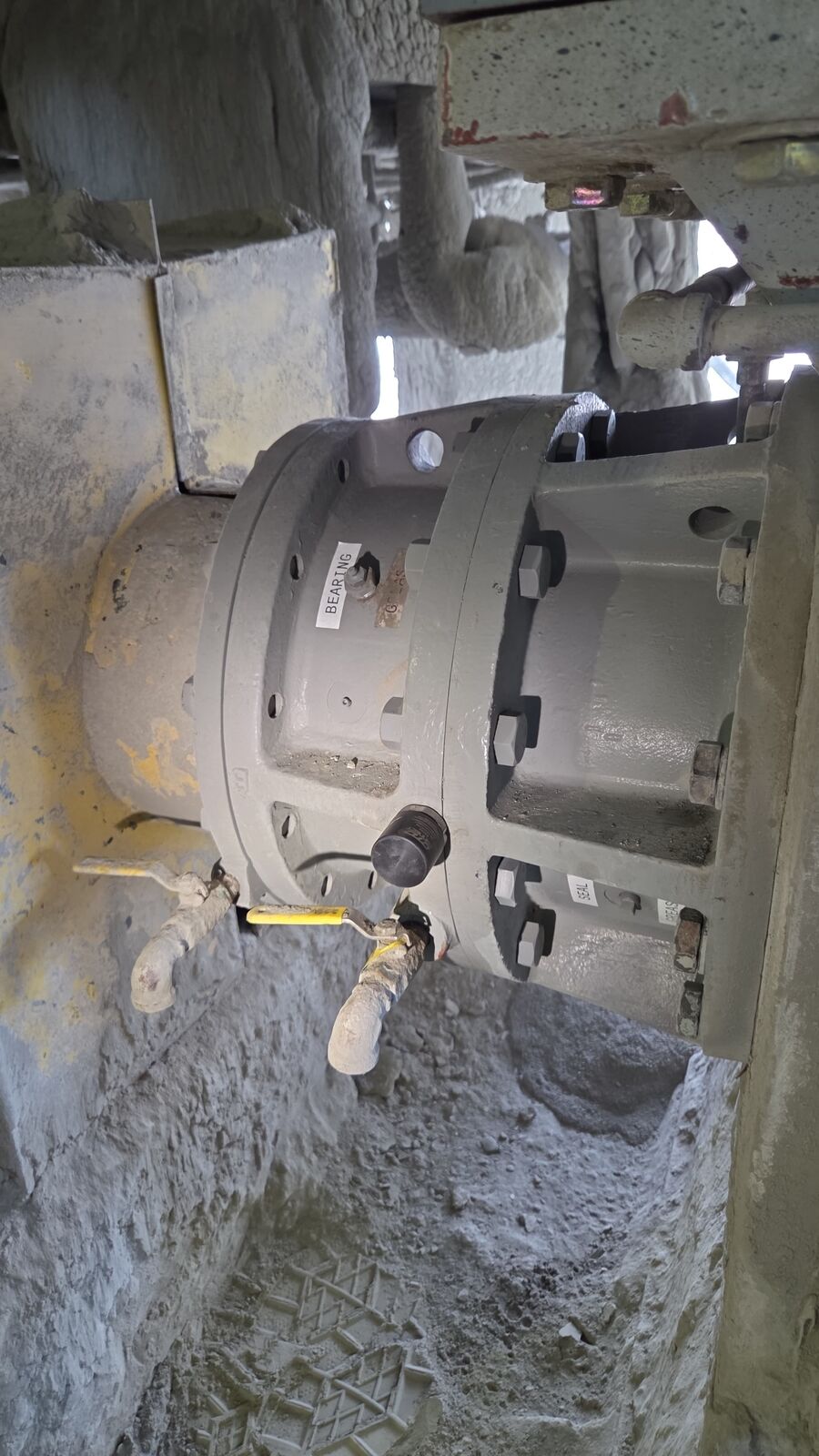
On the bearing housing, next to the grease lines — mounted in minutes on equipment that kept running.
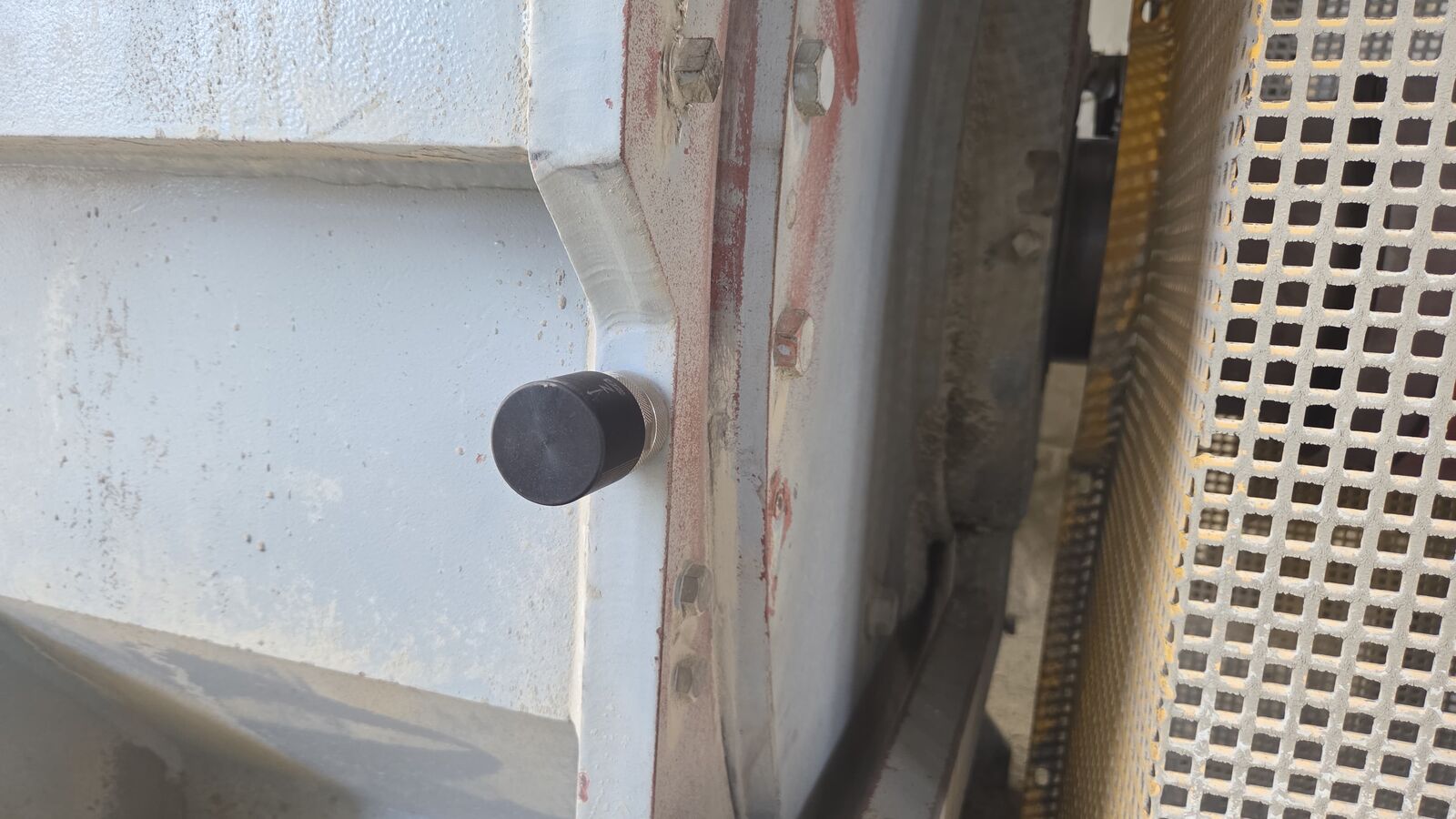
On the frame of a vibrating screen — the kind of rough, dusty spot where wired instrumentation goes to die.
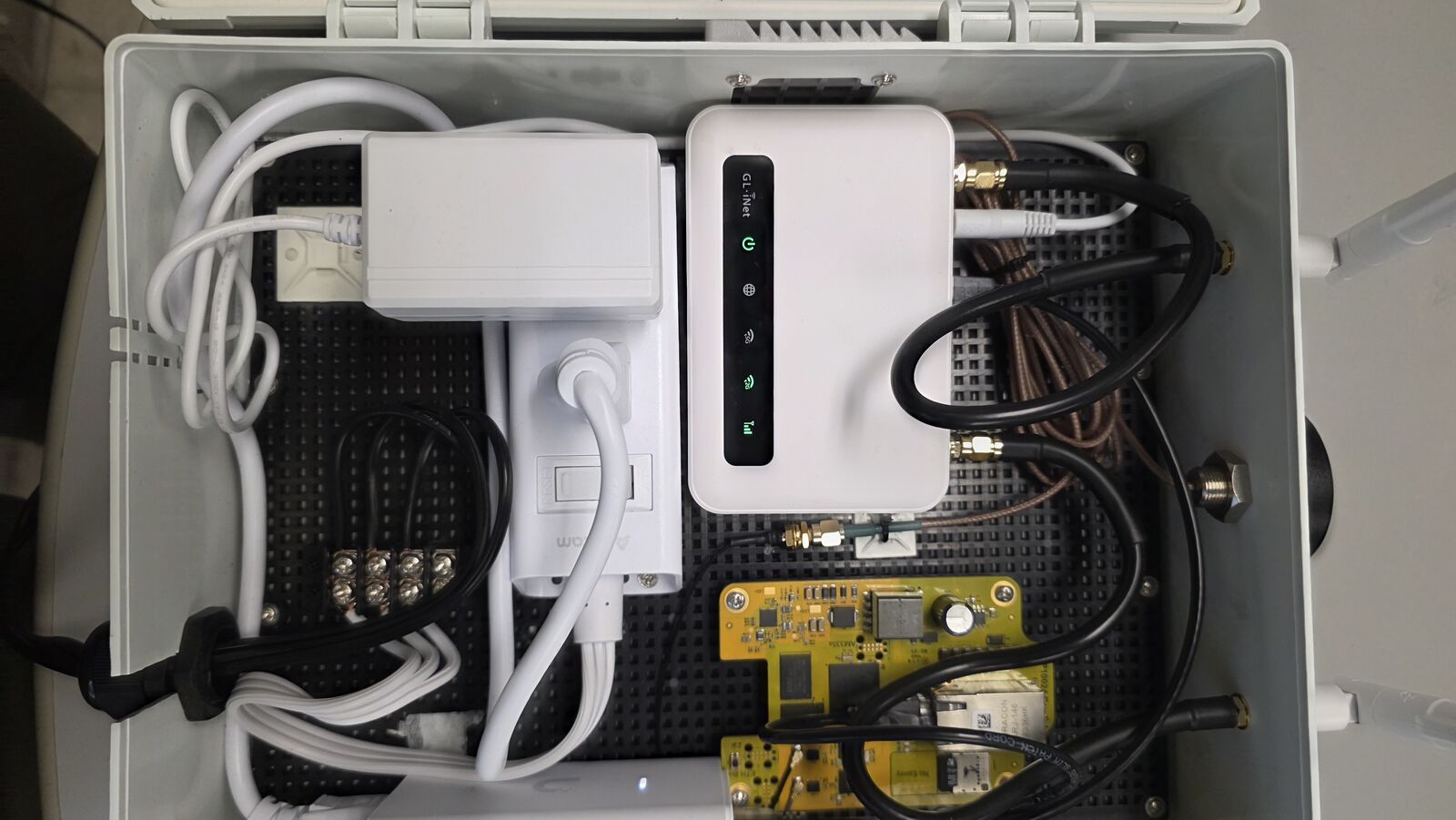
The entire "server room": one enclosure with the gateway card, the cellular router, and power. This is the box on the wall.
Install: mount the sensor, pair it, done. No shutdown required, no permits for hot work, no cable pulls.
Commission: the gateway powers up and finds its way out over cellular on its own.
Operate: open the URL. There is no client software, no VPN for users, nothing to patch on your side.
The entire on-site footprint is a sensor on a machine and a box on a wall. Everything else is our problem — which is the point.
The product
Everything the maintenance team needs, one URL.
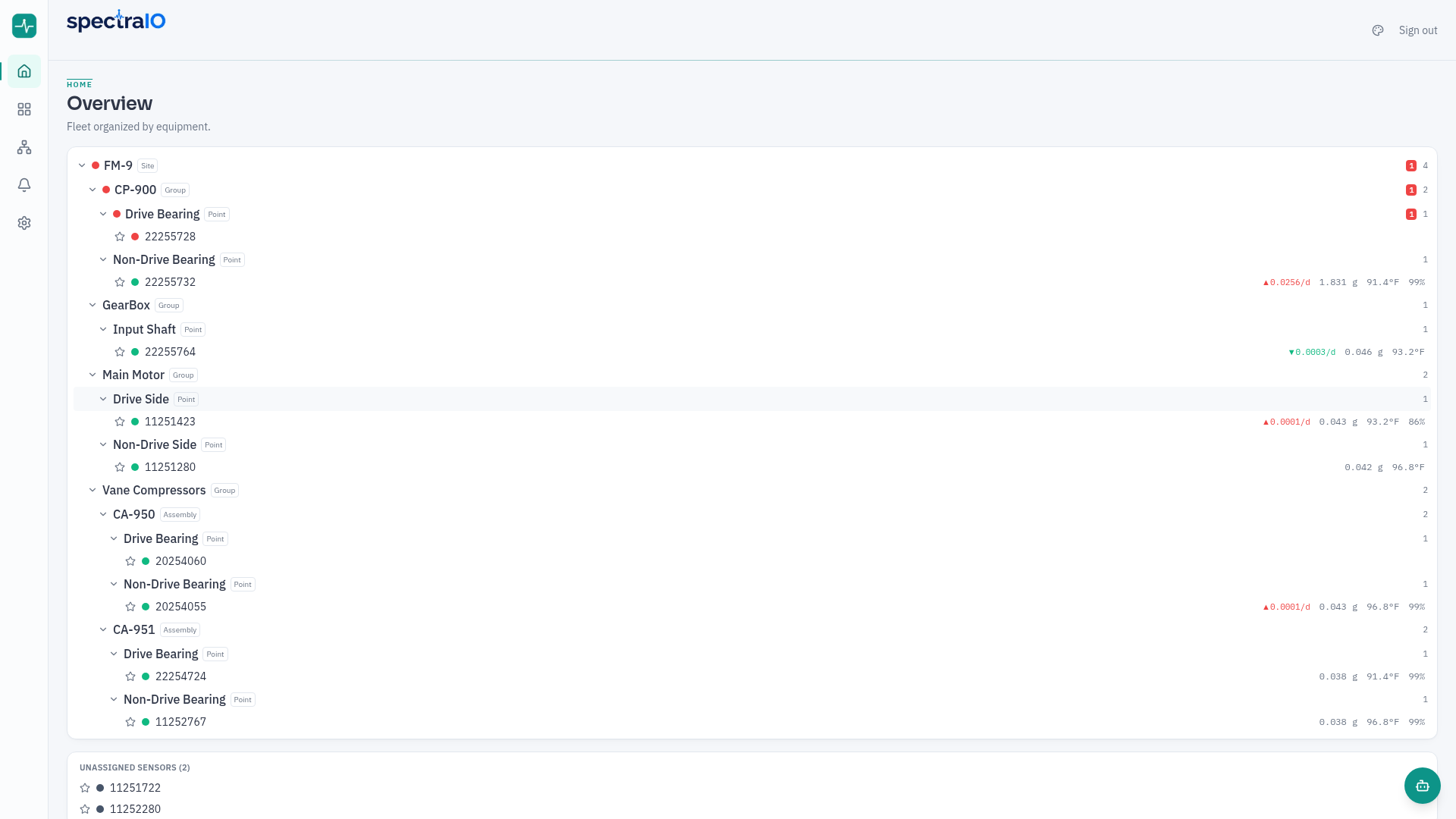
A fleet view that reads like your plant — sites, equipment, assemblies, bearings — with live severity, trend arrows, and drill-down to every reading.
The whole fleet, organized by equipment, severity at a glance.
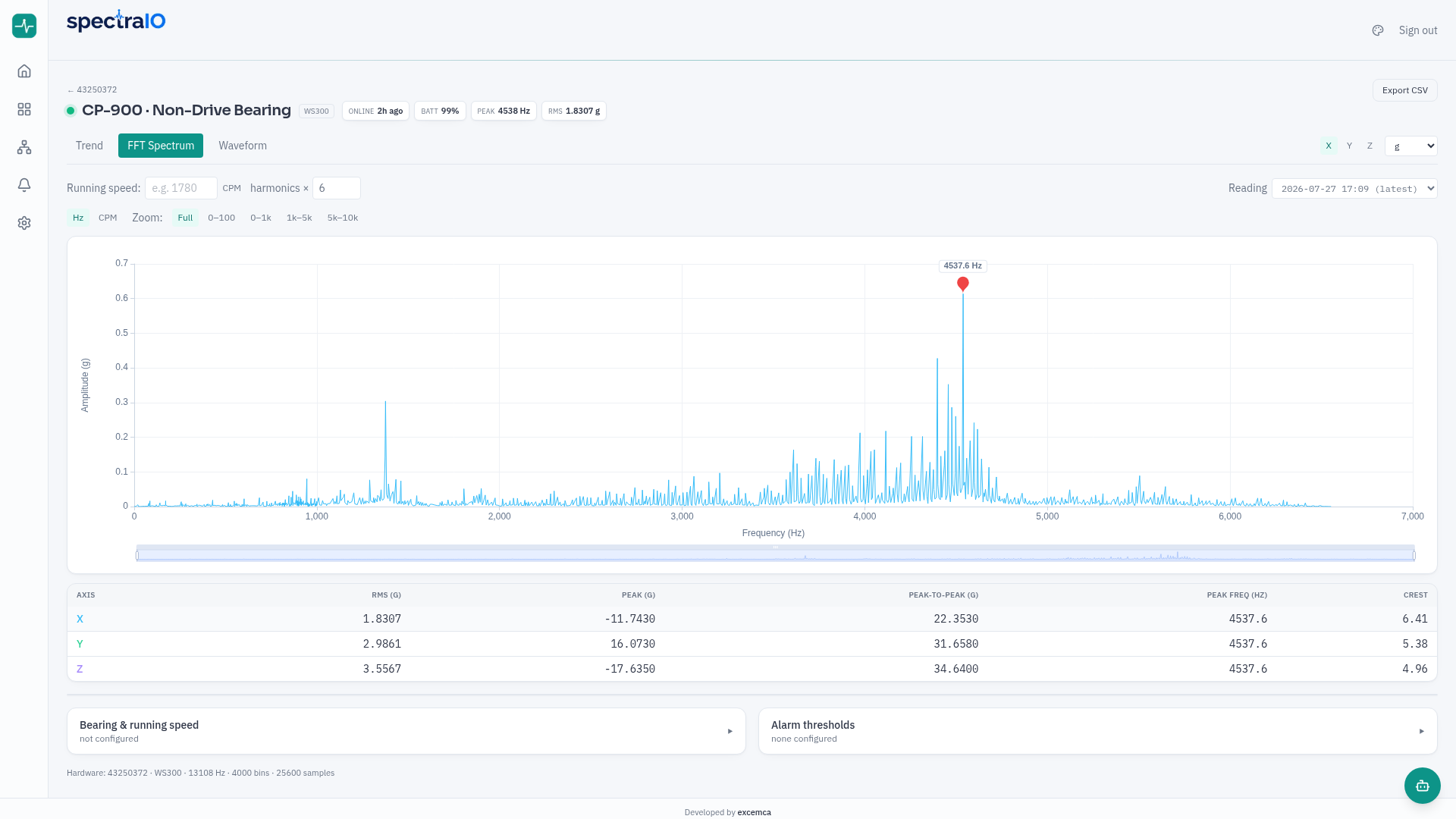
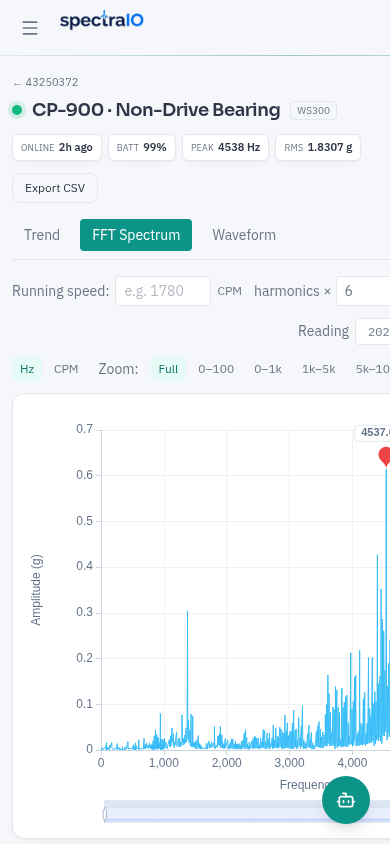
Full-resolution spectrum with harmonic ruler and axis switching.
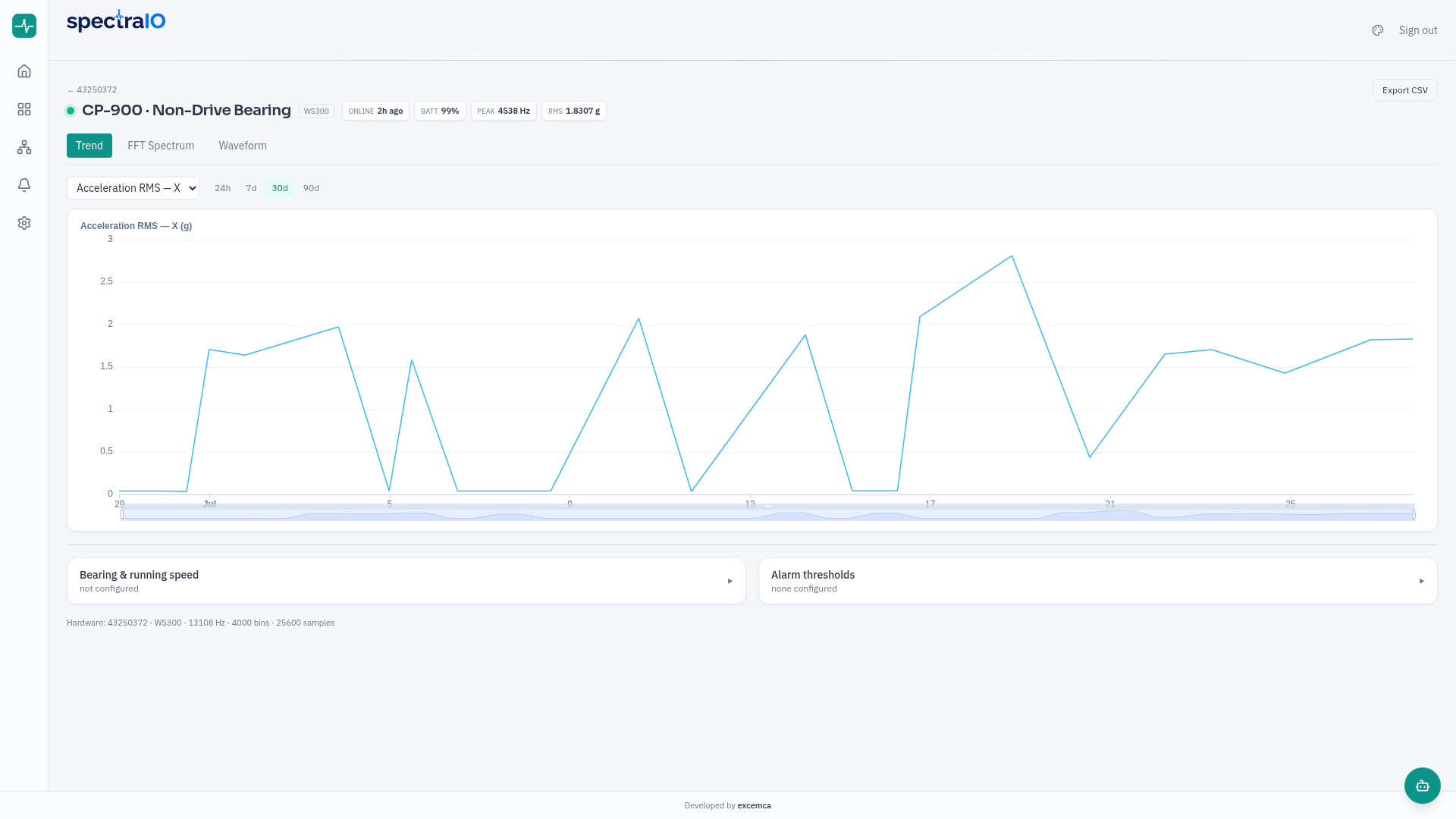
RMS and band trends over any window — the story of the machine.
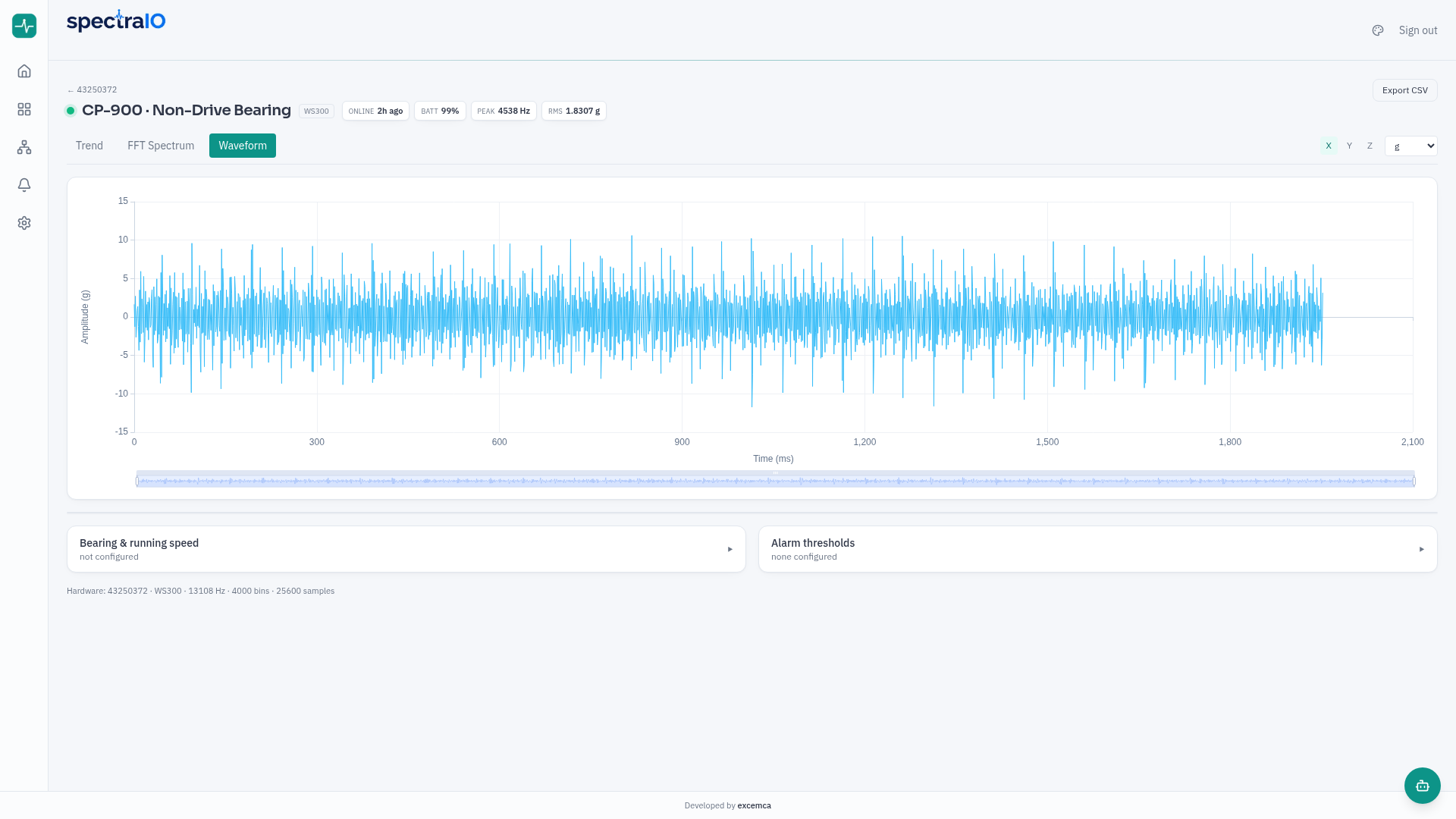
Raw time waveform, every stored sample on screen.
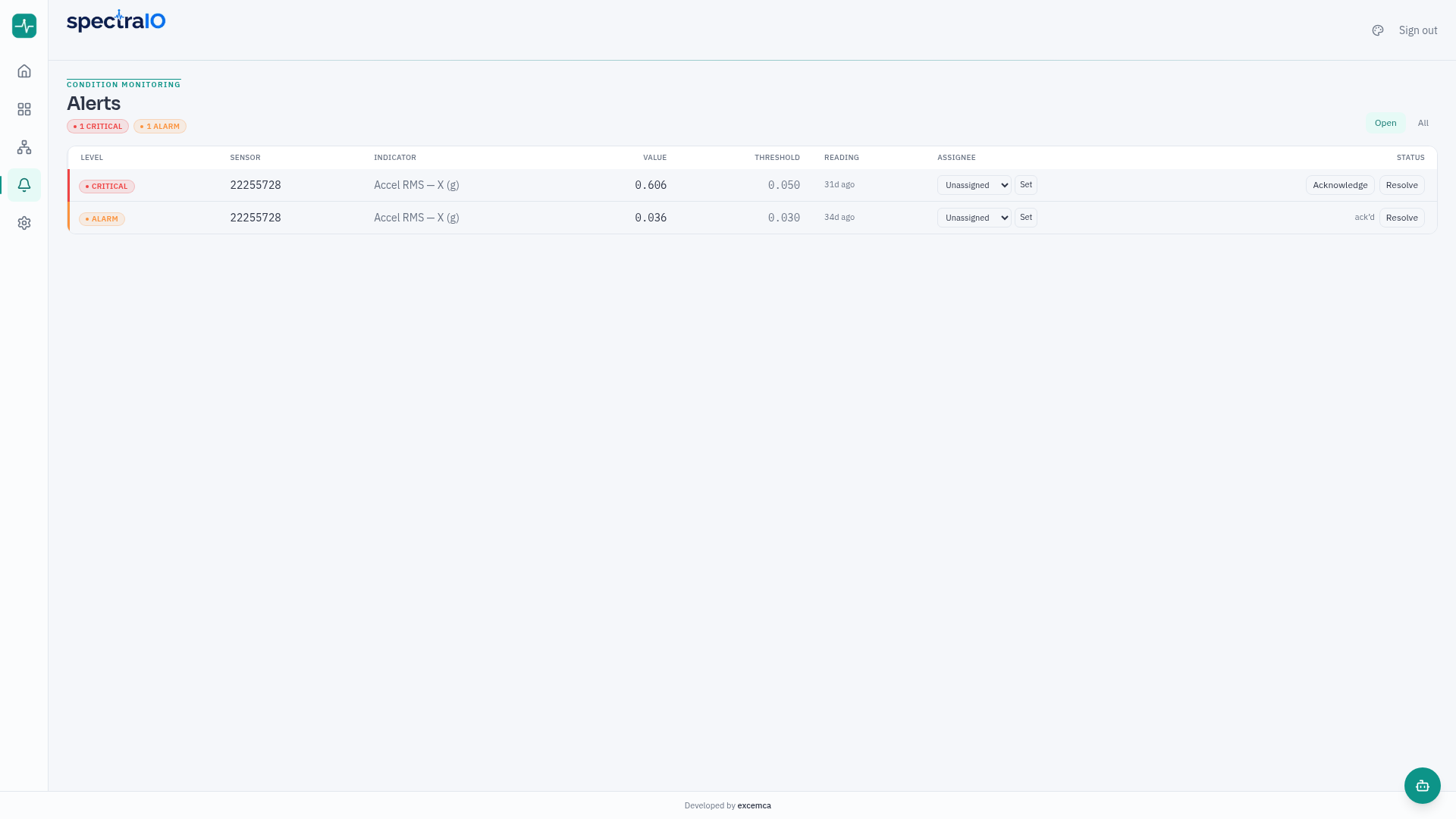
Alert workflow: acknowledge, assign, resolve — with an audit trail.
The same platform in your pocket, built for the plant floor.
Deep diagnostics
Analyst-grade FFT, every stored point on screen.
Most dashboards decimate the spectrum to fit the screen and quietly throw away the resolution your analyst needs. Spectra-IO renders every stored point — up to 4,000 bins per axis, with native resolution kept where bearing analysis happens.
Harmonic ruler — anchor a base frequency and read its multiples straight off the spectrum.
Bearing fault frequencies — configure the bearing and running speed, and the platform knows where BPFO, BPFI, BSF, and FTF should appear.
Hz and CPM, zoom bands, axis switching — the workflow a vibration analyst actually uses, in a browser.
This is the difference between "the app shows a chart" and "the analyst can make the call from the chart."
Proof
Running today at an operating cement plant.
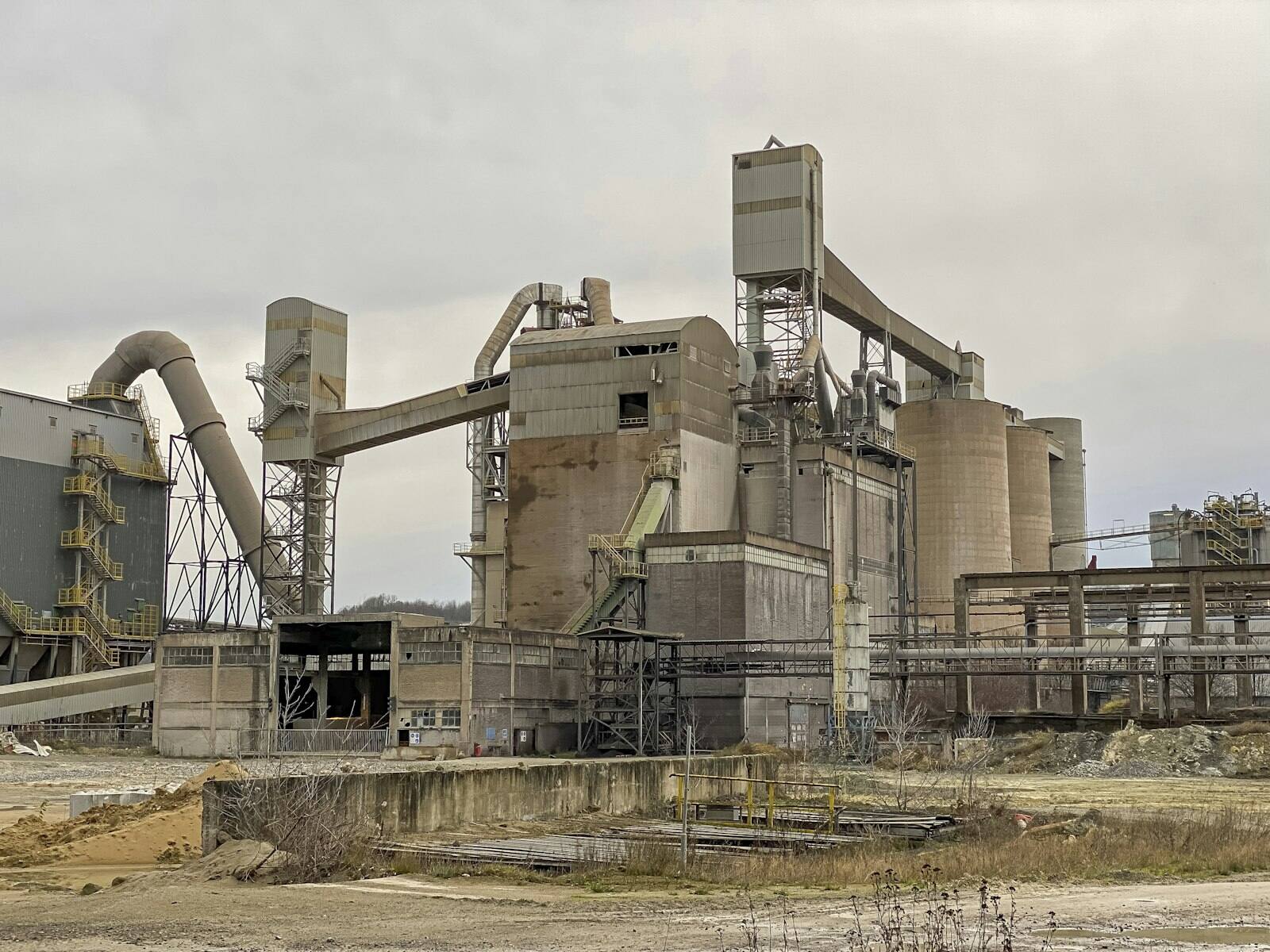
Spectra-IO is not a prototype. It monitors rotating equipment at an operating cement plant — crushers, compressors, gearboxes — streaming readings around the clock over cellular, through dust that eats lesser hardware for breakfast.
Two organizations use the platform in production today. The system has survived contact with the real world: heat, dust, vibration, and the industrial network conditions that kill demo-grade solutions.
The best reference for an industrial product is simple: it is already doing the job, somewhere real.
Where it goes next
From the plant floor to the oil field.
Inside a plant, sensors sit close together and one gateway covers them. But a lot of critical equipment doesn't live in a plant — it's scattered across kilometers: well clusters, pump stations, remote skids.
That's a radio problem, and the platform is ready for it. With long-range LoRaWAN nodes, a handful of gateways can cover an entire field of dispersed assets — years of battery per node, no SIM card per machine, no trenching. The platform ingests standard MQTT either way: the radio is an interchangeable detail, not a new system.
Dispersed extraction assets — exactly what long-range, low-power radio was designed for.
The same platform, the same dashboards — from a single plant to an entire field.
One platform, many radios: monitor the compressor room today and the well cluster tomorrow — without buying a second system.
Next step
See your own plant in it.
The fastest way to evaluate Spectra-IO is a pilot: a few sensors on the machines that worry you most, one gateway, and your data flowing within days — weeks, not months, to a decision.
You pick the machines — the ones whose failure hurts.
We install and commission — minutes per sensor, no shutdown.
You watch your own data — trends, spectra, and alerts on your equipment, not a demo dataset.
Ask for a pilot and put the platform where it belongs: on your machines.